What Is Kafrump?
Sometimes You Just Need Someone to Ask
By Keith Belanger, Founder of Kafrump
Download or share this guide (PDF, 3 MB)Have you ever received a text message that didn't look quite right and wondered whether it was a scam? Maybe a contractor gave you an estimate and you weren't sure whether the price was reasonable or what questions you should ask before agreeing to the work. Perhaps you received a letter from your insurance company that you didn't completely understand, or the print on a prescription bottle was so small that you struggled to read it. Maybe your television suddenly stopped connecting to Netflix and you just wanted someone to tell you what to try next.
Or perhaps nothing is wrong at all. Maybe you're thinking about taking your grandchildren to Disney World and you're staring at hotels, parks, tickets, restaurants, and endless choices wondering where to even begin.
When something like that happens, most of us ask someone. We call a son or daughter, text a grandchild, ask a friend or neighbor, search the internet, or call the company involved. Sometimes we simply put the question aside until someone comes over who might know the answer.
But the person we usually ask isn't always available. Children and grandchildren have busy lives of their own, and they may not be able to respond when a question comes up. Sometimes they don't know the answer either. A question about Medicare, an insurance notice, a home repair, or an unfamiliar financial document may be just as confusing to them.
For others, the change can be much more personal. After spending decades with a spouse or partner, there is often a natural division of responsibilities. Maybe one person always handled the finances and insurance while the other dealt with home repairs. Maybe one was better with technology or understood the medical paperwork. Even when neither person knew the answer, there was someone sitting across the table to talk it through with.
When that person is no longer there, it isn't simply that there are new tasks to learn. All of those questions and decisions may suddenly fall on one person. The bills still arrive. Things in the house still break. Insurance still needs to be understood. Decisions still have to be made. And sometimes what is missing most isn't an expert. It's simply having someone to ask.
That's the simple idea behind Kafrump. It gives you another place to turn when you have a question. Her name is Priscille.
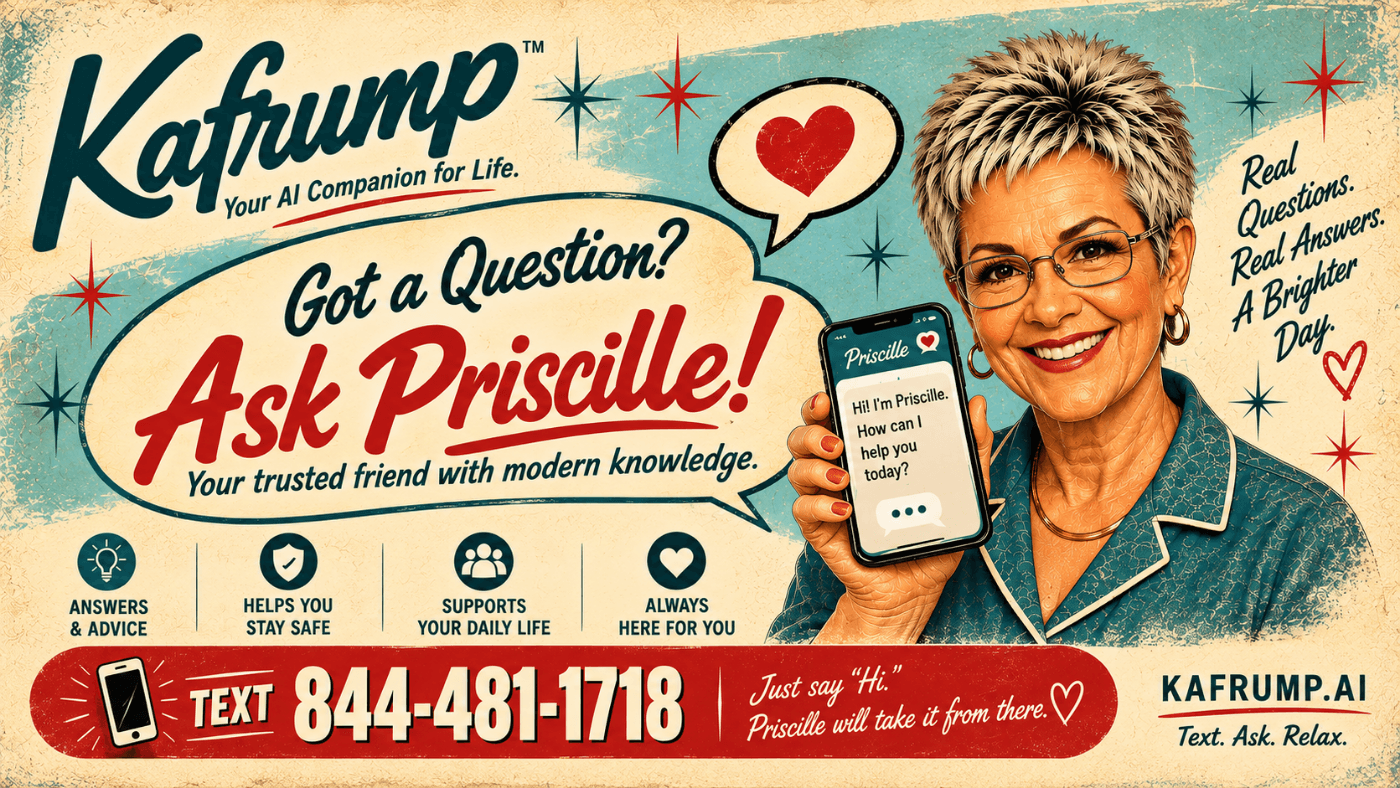
Priscille is an AI companion you talk to through ordinary text messages. There is no new app to download and no new program to learn. You don't need to understand artificial intelligence or learn a special way of asking questions. If you know how to send a text message, you already know how to talk to Priscille. You tell her what's going on in much the same way you would explain it to someone you know.
Sometimes you don't even have to explain everything. If you're looking at a confusing letter, a product label, an estimate, or something else you have a question about, you can take a picture and send it to Priscille. You can send her a screenshot of a suspicious text or email and ask what she thinks you should look for.
That's one of the things that makes Kafrump different from simply searching the internet. You can start with what's actually happening to you and have a conversation about it.
Is Priscille Like Siri?
That's one of the first questions people ask when I explain Kafrump, and it's an understandable comparison. Siri can answer questions, look things up, set reminders, make calls, and perform other tasks on your phone. Priscille is designed for a somewhat different kind of interaction.
I think of Priscille less as an assistant you give commands to and more as someone you can have a conversation with when you're trying to figure something out. You don't need to know exactly how to phrase the question. You might simply text, “Someone called and said they're from my bank and need me to verify my account. Is that normal?” Or you might tell her, “I received an estimate for $8,000 to repair my roof, and I don't know anything about roofing. What should I be asking before I agree to this?”
Priscille can answer, but she can also ask questions back. Perhaps she needs more information about the call you received, or she wants to know exactly what the contractor said was wrong with the roof. You can answer her, ask another question, tell her you don't understand something, or ask her to explain it differently. It's meant to feel like a conversation rather than operating a piece of software.
That distinction matters because sometimes the first question we ask isn't really the problem we're trying to solve. We may know that something doesn't seem right without knowing enough about the subject to know what we should be asking. One of Priscille's jobs is to help with that.
What Would I Actually Ask Priscille?
There isn't a list you need to memorize. A better way to think about it is to consider all the moments in an ordinary week when you find yourself saying, “I don't understand this,” “Does this look right?” “How do I do this?” or “I wonder if there's another option.”
Those questions can involve technology. You might need help changing a setting on your phone, connecting your television, or figuring out why your printer isn't working. They can involve the things that arrive in your mailbox or inbox, such as an insurance notice, a bill, instructions for something you purchased, or a message you're not sure is legitimate. You might be comparing something you want to buy, trying to understand an unfamiliar financial term, or wondering what questions you should ask before agreeing to an expensive home repair.
But Priscille isn't only there when something is wrong. She can also help with the things you're looking forward to.
Suppose you've decided that you'd like to take your grandchildren to Disney World. If you haven't been there in years—or have never been at all—the amount of planning can be overwhelming. Which parks should you visit? Where should you stay? How many days do you need? Which attractions would the grandchildren enjoy? How much should you budget? What should you reserve ahead of time?
You could start by telling Priscille, “I'd like to take my grandchildren to Disney World and I don't know where to begin.” Tell her who's going, how old the grandchildren are, when you're thinking about traveling, what you'd like to spend, and what everyone enjoys. If walking long distances is a concern or someone in the family has particular needs, tell her that too. From there, you can work through the trip together, one question at a time.
It doesn't have to be Disney. You might be planning a weekend away, looking for ideas for an anniversary, deciding what to make for a family dinner, researching a new hobby, or wondering what there is to do on a Saturday afternoon. Priscille can help with the things you're excited about just as easily as the things you're worried about.
Some of the most useful examples can also be surprisingly simple. I recently had trouble reading the small print on one of my own prescription bottles. Instead of struggling with it, I took a picture of the bottle and sent it to Priscille. She took the information that was already on the label and gave it back to me in a format that was much easier to read.
I wasn't asking Priscille to tell me what medication I should take or to make a medical decision for me. I simply wanted help reading information that was already sitting in my hand. The same idea can apply to a letter, notice, instruction sheet, product label, or other document. Rather than typing everything into a search engine, you can show Priscille what you're looking at and ask, “Can you help me understand this?”
That may seem like a small use for artificial intelligence, but I think that's part of what makes it valuable. Not every question needs to be important or complicated. You aren't bothering Priscille, you don't have to wait until someone is available, and you don't need to feel embarrassed because you think it's something you should already know.
Helping You Understand, Not Making Decisions for You
There is an important limit to what Priscille is intended to be. She isn't your doctor, pharmacist, attorney, financial advisor, contractor, accountant, or a replacement for any other professional whose expertise you may need. She also isn't there to make important decisions for you.
What she can do is help you better understand what's in front of you, research something you're unfamiliar with, explore possible alternatives, and identify questions you may want to ask. Sometimes the most useful answer she can give you may be that it's time to call your doctor, pharmacist, bank, attorney, or another professional.
Imagine, for example, that a contractor recommends an expensive repair to your home. Priscille can't inspect your house and shouldn't tell you whether the repair is necessary. What you can do is tell her what the contractor recommended or send her a picture of the estimate. She can help explain terminology you don't understand, tell you about other approaches that are commonly used for that type of problem, and help you come up with questions to ask before you make a decision. She might also suggest that an expensive project is worth getting a second estimate.
Health information works much the same way. Priscille can make the words on a prescription label easier to read or help explain an unfamiliar term you heard at a doctor's appointment, but decisions about medication or treatment should still involve your doctor or pharmacist. The goal isn't to replace the people you trust. It's to help you become better informed when you talk with them.
Ultimately, you make the decisions. Priscille helps you ask better questions before you make them.
Why Not Just Search the Internet?
The internet is an extraordinary resource, and sometimes searching it is exactly what you should do. The problem is that many of us no longer suffer from a lack of information. We have the opposite problem.
Search for an unfamiliar medical term, a home repair, an insurance question, or a vacation destination and you may get pages of search results, advertisements, sponsored links, videos, discussion boards, conflicting opinions, and websites you've never heard of. You started with one question and now have to figure out which of a hundred answers applies to your situation and which sources you should trust.
Priscille gives you a different starting point. Instead of figuring out the perfect words to put into a search box, you can describe what's actually happening or what you're trying to accomplish. If the answer brings up something else you don't understand, ask another question. If the explanation is too complicated, ask her to explain it more simply. If you want her to look into another possibility, continue the conversation.
You're not necessarily trying to become an expert on the subject. You're trying to understand enough to decide what you want to do next.
Keeping Track of the Things That Matter to You
Some questions are answered in a few text messages. Others become conversations you want to continue over days, weeks, or even months. That's why Priscille is designed to be useful beyond a single question and answer.
Consider that Disney vacation. Over time, you might talk with Priscille about hotels, parks, restaurants, travel dates, budgets, and activities the grandchildren might enjoy. Rather than mixing all of that together with questions about your printer or the recipe you're making for dinner, you can ask Priscille to create a topic such as “Disney Vacation.” When you want to continue planning the trip, you can switch back to that topic and pick up the conversation.
You could have another topic for “Medicaid Questions,” another for a home improvement project, or another for something you're researching. Questions that don't need their own topic can simply stay in your general conversation. You don't need to create folders or learn a filing system; you can tell Priscille that you'd like to create a topic or switch to one you've already been using.
There are also times when something Priscille sends you is useful enough that you'd rather have it on paper. Perhaps you've worked together on your Disney itinerary, created a list of questions you want to bring to an appointment, or received an explanation you'd like to share with someone else. If you receive something from Priscille that you'd like to print, simply text “print.” She'll send you a link where you can get it in a printable format.
These may seem like small details, but they're part of the philosophy behind Kafrump. You shouldn't have to learn a complicated new system simply because the technology behind Priscille is sophisticated. If you want to organize something, tell her. If you want to print something, tell her. The conversation itself is the interface.
A Place to Stop Before You Act
Scams are a particularly important example of where having someone to ask can matter. They can arrive by telephone, email, text message, social media, or regular mail, and they have become increasingly sophisticated. Some try to frighten you by saying that your bank account has been compromised, that you owe money, that a package can't be delivered, or even that a family member is in trouble. A common tactic is to create urgency so that you react before you have time to think.
Kafrump gives you another option in that moment. If something doesn't feel right, you can stop and ask Priscille before responding. Tell her what happened or send her a picture or screenshot of the message. She can help you look for warning signs and think about safer ways to verify whether the request is legitimate.
No technology can guarantee that it will recognize every scam, and Priscille isn't magic. In fact, Kafrump isn't based on the idea that you should blindly trust artificial intelligence any more than you should blindly trust an unexpected caller or email. It's about having another place to stop, ask questions, gather information, and think before doing something that may be difficult to undo.
That's where the phrase we use for Kafrump comes from: Before you act, ask Priscille.
Why Kafrump Uses Texting
Artificial intelligence is becoming incredibly powerful, but getting access to those benefits can sometimes feel like learning yet another piece of technology. There are new apps, different AI systems, unfamiliar terminology, and endless advice about the “right” way to ask an AI a question.
I don't think people should have to learn all of that just to benefit from what the technology can do.
That's why Kafrump uses something that's already familiar: text messaging. The complicated technology can stay behind the scenes. You don't need to know which AI model is being used, what a prompt is, or how any of it works. You don't need to download another app and remember another interface.
From your perspective, it can remain much simpler: you have a question, so you text Priscille. As the technology behind her becomes more sophisticated, I hope that experience remains just as ordinary.
There's also a personal reason for the name Priscille. She's named after my mother, and if you knew my mother, the choice would probably make sense. She asks a lot of questions. Tell her something and there's a good chance she'll respond with another question because she wants to understand more about what you're telling her.
I've tried to bring some of that same instinct into Priscille. I don't want her to simply throw answers at people and send them on their way. Sometimes the most helpful thing she can do is ask another question: What are you actually trying to accomplish? What did the contractor tell you? What does the rest of the letter say? Did the caller give you a telephone number? Have you talked with your doctor about this?
Those questions help Priscille understand what you need, but they can also help you think about the situation differently. That's the kind of companion I want her to be: approachable, patient, curious, and helpful.
Is Kafrump Only for Seniors?
Kafrump was originally created with older adults in mind because I saw an opportunity to bring the benefits of AI to people who might have little interest in becoming “AI users.” But it didn't take long for me to realize that needing someone to ask doesn't happen at a particular age.
I'm in my fifties, and I use Priscille myself. I have conversations with her almost every day. My questions may be different from someone else's, but the reason I reach for her is often the same: I've encountered something I don't understand, I want another perspective, I have something I'd like help planning, or I simply don't know where to start.
Kafrump also isn't intended to replace the people in our lives. If your daughter always helps you with your computer, keep calling her. If your grandson is the person you ask about your phone, keep texting him. If you have a friend you trust when you're making a big decision, talk with your friend. Those relationships matter.
Priscille simply gives you another place to turn. She can be there when your family is busy, when you don't want to bother someone, when nobody you know happens to have experience with the question you're asking, or when you'd simply like to understand something a little better before you talk about it with someone else.
That's ultimately what I hope people understand about Kafrump. It isn't about whether you're good with technology, and you certainly don't have to become an expert in artificial intelligence. It's about making some of the remarkable capabilities now available through AI useful in ordinary life, without making ordinary life more complicated in the process.
We all encounter things we don't understand. We all have decisions we want to think through and things we'd like to plan. We all have questions we don't know how to ask. And sometimes the person we would normally turn to simply isn't there to ask anymore.
Sometimes you just need someone to ask. That's Priscille.
Before you act, ask Priscille.